
Introduction
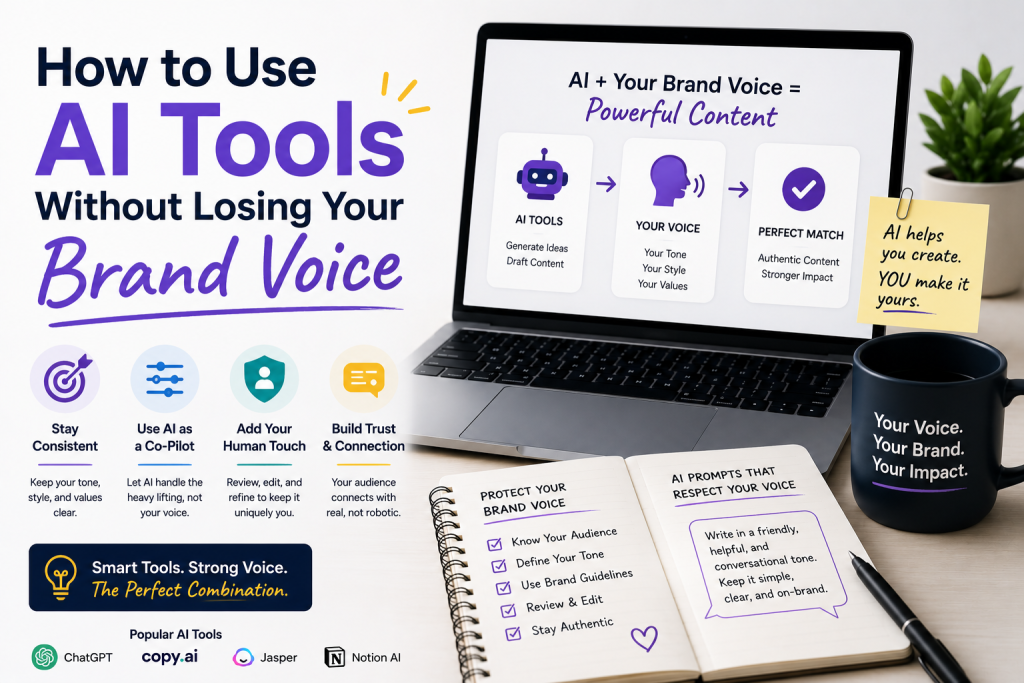
Artificial intelligence (AI) has transformed the way businesses create content, manage marketing campaigns, and communicate with customers. From generating blog posts and social media captions to writing emails and product descriptions, AI tools can significantly improve productivity and reduce the time spent on repetitive tasks.
However, while AI offers remarkable efficiency, it also presents a challenge that many brands overlook: maintaining a consistent and authentic brand voice.
Your brand voice is more than the words you use—it’s the personality, tone, values, and style that shape how your audience perceives your business. If every piece of content sounds generic or inconsistent, customers may struggle to recognize your brand, trust your message, or build a lasting connection with your business.
The good news is that you don’t have to choose between AI and authenticity. When used strategically, AI can enhance your content creation process while preserving the unique voice that sets your brand apart.
In this guide, we’ll explore practical ways to use AI tools effectively without losing the personality and consistency that make your brand memorable.
What Is Brand Voice?
Brand voice is the distinct way your business communicates with its audience across every platform, including your website, blog, social media, emails, advertisements, and customer support.
It reflects your company’s personality and influences how customers feel about your brand.
For example, your brand voice may be:
- Professional and authoritative
- Friendly and conversational
- Inspirational and motivational
- Playful and humorous
- Educational and informative
- Luxury-focused and sophisticated
A consistent brand voice helps customers recognize your content immediately, regardless of where they encounter it.
Why Brand Voice Matters
In today’s crowded digital landscape, customers interact with countless brands every day. Products and services may be similar, but a strong, recognizable voice creates a lasting impression.
A consistent brand voice can:
- Build trust and credibility
- Strengthen brand recognition
- Improve customer loyalty
- Create emotional connections
- Differentiate your business from competitors
- Increase engagement across marketing channels
When your messaging is consistent, customers know what to expect, making your brand feel reliable and authentic.
The Benefits of Using AI for Content Creation
AI tools have become valuable assistants for marketers, writers, and business owners.
They can help with:
- Generating content ideas
- Drafting blog posts
- Writing email campaigns
- Creating social media captions
- Improving grammar and readability
- Summarizing long documents
- Repurposing existing content
- Conducting basic research
- Translating content
- Optimizing content for SEO
By automating repetitive tasks, AI allows teams to focus on strategy, creativity, and customer relationships.
However, efficiency should never come at the cost of authenticity.
The Risks of Relying Too Much on AI
Although AI is a powerful tool, using it without proper guidance can make your content sound generic and inconsistent.
Common risks include:
Generic Messaging
AI often generates content that is grammatically correct but lacks originality or personality.
Inconsistent Tone
Without clear instructions, AI may produce formal content one day and casual content the next.
Loss of Brand Identity
If every business relies on default AI outputs, brands begin sounding alike.
Inaccurate Information
AI can occasionally generate incorrect or outdated facts, making human review essential.
Reduced Emotional Connection
1. Define Your Brand Voice Clearly
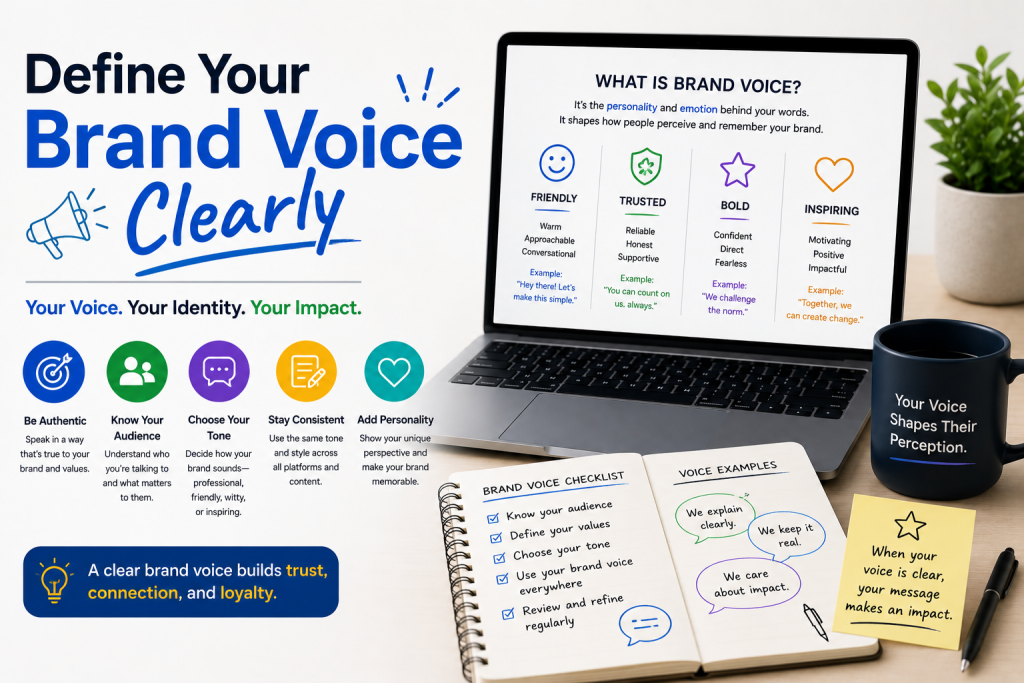
Before using AI, establish clear brand voice guidelines.
Ask yourself:
- How do we want customers to perceive us?
- What words describe our personality?
- What tone should we avoid?
- How formal or casual should we sound?
- What values should every piece of content communicate?
Document these guidelines so everyone on your team follows the same standards.
Example:
Tone: Friendly, knowledgeable, and professional
Avoid: Overly technical jargon, exaggerated claims, and robotic language
The clearer your guidelines, the better AI can support your content creation.
2. Use AI as a First Draft, Not the Final Copy
One of the most effective ways to preserve your brand voice is to treat AI-generated content as a starting point rather than a finished product.
Let AI handle:
- Research outlines
- Initial drafts
- Headline ideas
- Content structures
- Brainstorming sessions
Then edit the content to reflect your unique voice.
Add:
- Real experiences
- Customer insights
- Industry expertise
- Brand-specific language
- Personal examples
- Original opinions
Human editing transforms generic content into authentic communication.

3. Create Brand-Specific AI Prompts
The quality of AI-generated content depends heavily on the instructions you provide.
Instead of writing:
“Write a blog about SEO.”
Try:
“Write a professional, educational blog for small business owners. Use a friendly and trustworthy tone, avoid jargon, provide actionable advice, and maintain a conversational style that reflects our brand values of honesty, simplicity, and expertise.”
Detailed prompts produce more relevant and consistent results.
4. Build a Brand Style Guide
A comprehensive style guide ensures consistency across all content.
Include:
Writing Style
- Short or long sentences
- Formal or conversational language
- Preferred vocabulary
- Grammar preferences
Formatting
- Heading styles
- Bullet points
- Paragraph length
- Capitalization rules
Messaging
- Mission statement
- Brand values
- Key selling points
- Customer promises
Visual Identity
- Colors
- Typography
- Logo usage
- Image style
Your style guide becomes the foundation for both human writers and AI tools.

5. Add Human Stories and Real Experiences
AI can organize information, but it cannot replace authentic human experiences.
Customers connect with:
- Success stories
- Lessons learned
- Client case studies
- Behind-the-scenes insights
- Personal opinions
- Team experiences
These elements make your content more relatable and memorable.
Whenever possible, include real examples that reflect your company’s expertise and values.
6. Maintain Consistency Across Every Channel
Your audience interacts with your business through multiple touchpoints.
Whether someone reads your:
- Website
- Blog
- Email newsletter
- Social media posts
- Advertisements
- Customer support messages
…the tone should feel familiar.
Review AI-generated content before publishing to ensure consistency across all channels.
7. Train Your Team to Work with AI
AI should complement your team—not replace it.
Teach employees how to:
- Write effective prompts
- Verify facts
- Edit AI-generated content
- Follow brand guidelines
- Protect confidential information
- Add creativity and strategic thinking
The combination of AI efficiency and human expertise delivers the strongest results.
8. Fact-Check Every Piece of Content
Although AI can generate convincing text, it may occasionally include inaccurate or outdated information.
Before publishing:
- Verify statistics
- Confirm dates
- Check industry regulations
- Review technical details
- Validate product information
Accurate content strengthens your credibility and builds customer trust.
9. Keep Your Audience at the Center
AI should help you serve your audience—not simply produce more content.
Before publishing, ask:
- Does this answer a customer question?
- Is the information useful?
- Does it reflect our expertise?
- Would our audience find it engaging?
- Does it sound like our brand?
If the answer is yes, your content is likely on the right track.
10. Continuously Review and Improve
Brand voice evolves over time as your business grows and your audience changes.
Regularly review your content to ensure it remains:
- Relevant
- Consistent
- Helpful
- Accurate
- Authentic
Gather customer feedback, analyze engagement metrics, and refine your AI workflows based on what performs best.
Continuous improvement helps maintain a strong and recognizable brand identity.
Common Mistakes to Avoid
Many businesses unintentionally weaken their brand voice by making these mistakes:
- Publishing AI-generated content without editing
- Using inconsistent tones across platforms
- Ignoring brand guidelines
- Overusing buzzwords and clichés
- Failing to verify facts
- Prioritizing quantity over quality
- Removing all personality from content
Avoiding these pitfalls helps your brand remain distinctive and trustworthy.
The Future of AI and Brand Communication
As AI technology continues to evolve, it will become an even more valuable partner in content creation, customer service, and marketing. Businesses that succeed will be those that combine AI’s speed and efficiency with human creativity, empathy, and strategic thinking.
Rather than replacing your brand voice, AI should amplify it by helping your team create better content faster while preserving the authenticity that customers value.
Conclusion
AI tools have transformed the way businesses create content, offering faster workflows, greater efficiency, and new opportunities for growth. However, technology should never replace the unique personality that makes your brand recognizable and trustworthy.
By defining a clear brand voice, creating detailed style guides, writing effective prompts, editing every AI-generated draft, and adding genuine human insights, you can enjoy the benefits of AI while maintaining the authenticity your audience expects.
The most successful brands won’t be those that rely entirely on artificial intelligence or those that avoid it altogether. They will be the ones that use AI as a powerful assistant while ensuring that every piece of content reflects their values, expertise, and commitment to serving their customers. In a world where automation is becoming increasingly common, a consistent and authentic brand voice remains one of the strongest competitive advantages your business can have.