
Introduction
Running paid advertisements is one of the fastest ways to generate leads, increase website traffic, and boost sales. However, many businesses invest significant amounts in advertising only to see disappointing results. Low click-through rates, expensive cost-per-click, poor conversions, and wasted ad spend are common frustrations for marketers and business owners alike.
The truth is that successful advertising is not just about creating an ad and launching it. Every element—from audience targeting and ad copy to landing pages and campaign optimization—plays a critical role in determining performance.
If your ads aren’t delivering the results you expected, don’t assume advertising doesn’t work. More often than not, the issue lies in strategy rather than the platform itself. This guide explores the most common reasons ads fail and provides practical solutions to improve campaign performance and maximize your return on investment (ROI).
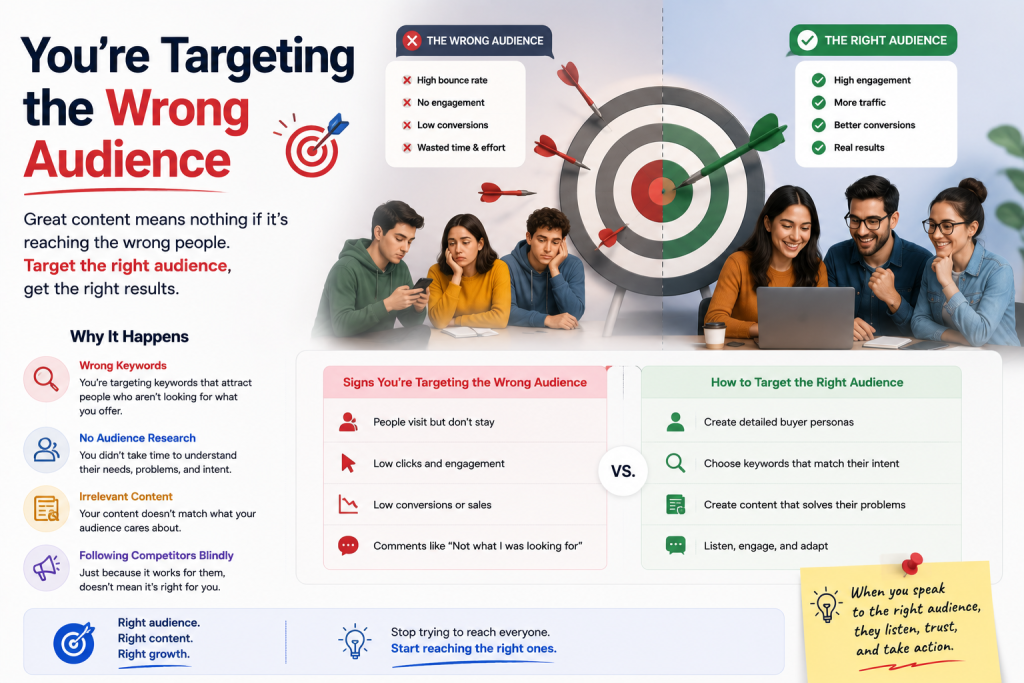
1. You’re Targeting the Wrong Audience
One of the biggest reasons advertising campaigns fail is poor audience targeting. Even the most compelling ad cannot generate results if it’s shown to people who have no interest in your product or service.
Many advertisers either target audiences that are too broad or choose demographics that don’t match their ideal customers.
How to Fix It
- Create detailed customer personas.
- Use demographic, geographic, and behavioral targeting.
- Build custom audiences from website visitors.
- Use lookalike audiences to find similar customers.
- Exclude irrelevant audiences to reduce wasted spend.
The more relevant your audience, the better your campaign performance.
2. Your Ad Copy Doesn’t Capture Attention
People scroll through hundreds of advertisements every day. If your ad fails to grab attention within the first few seconds, it will likely be ignored.
Weak headlines, generic messaging, and unclear value propositions often lead to poor engagement.
How to Fix It
Write copy that focuses on customer benefits rather than product features.
Instead of saying:
“We offer digital marketing services.”
Say:
“Increase your leads by 3X with data-driven digital marketing strategies.”
Use:
- Strong headlines
- Emotional triggers
- Clear benefits
- Social proof
- Powerful calls-to-action
Your ad should immediately answer the customer’s question:
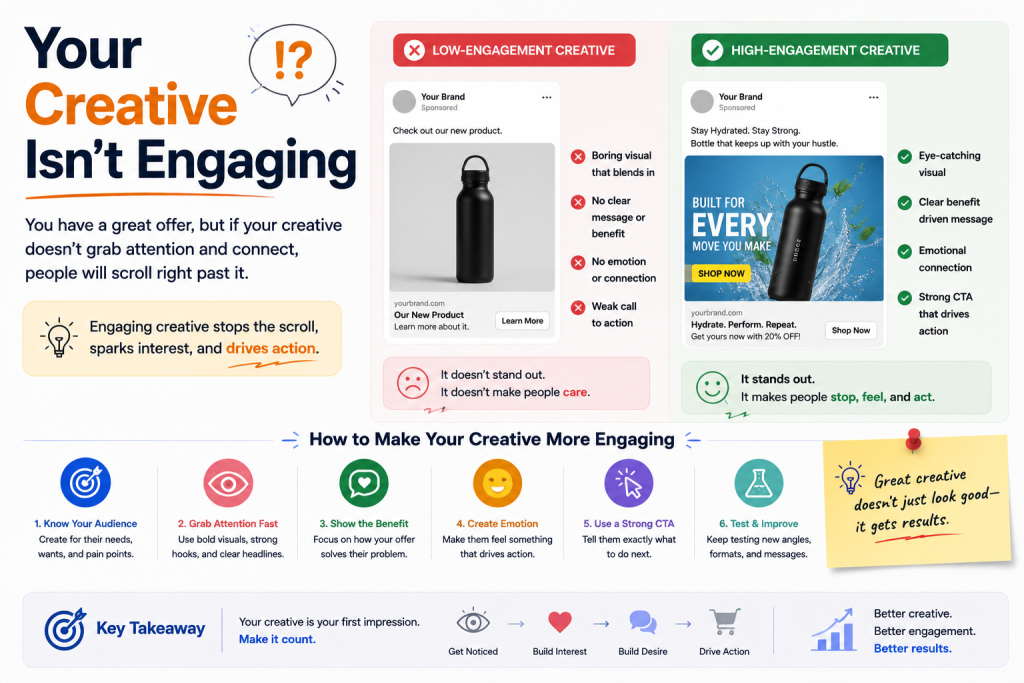
Your Creative Isn’t Engaging
Visuals are often the first thing users notice. Low-quality images, cluttered graphics, or outdated designs can significantly reduce engagement.
Videos, animations, and high-quality product images generally outperform basic graphics.
How to Fix It
Invest in professional creative assets.
Best practices include:
- High-resolution images
- Short, engaging videos
- Brand-consistent colors
- Easy-to-read text
- Mobile-friendly design
Remember, your creative should stop users from scrolling.
4. Your Landing Page Doesn’t Convert
Getting clicks is only half the battle. If visitors leave your website without taking action, your landing page is likely the problem.
Common issues include:
- Slow loading speed
- Poor mobile experience
- Too much information
- Confusing navigation
- Weak call-to-action
How to Fix It
Create dedicated landing pages for each campaign.
Ensure your landing page has:
- Clear headline
- Fast loading speed
- Trust signals
- Customer testimonials
- Simple forms
- Strong CTA button
Consistency between the ad and landing page builds trust and improves conversion rates.
5. You’re Ignoring Mobile Users
Today, the majority of online traffic comes from smartphones.
If your website isn’t mobile-friendly, you’re losing valuable customers.
How to Fix It
Optimize for mobile by:
- Using responsive design
- Compressing images
- Improving page speed
- Simplifying navigation
- Making buttons easy to tap
Always test your campaigns on multiple devices before launching.
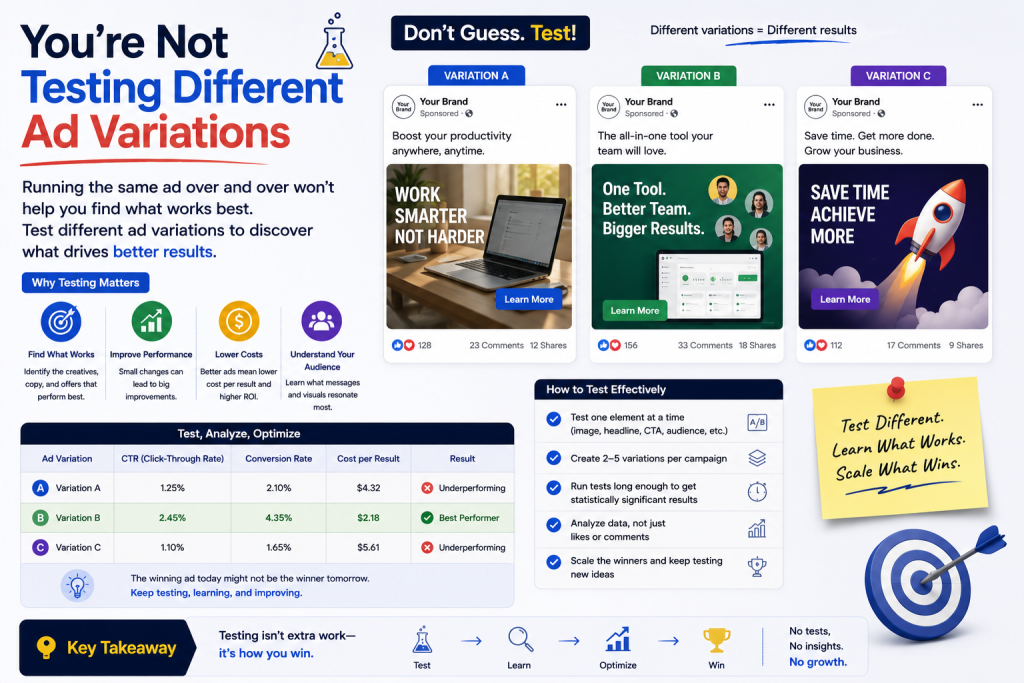
6. You’re Not Testing Different Ad Variations
Many advertisers create one advertisement and hope for the best.
Successful marketers continuously test different campaign elements.
Test These Variables
- Headlines
- Images
- Videos
- CTA buttons
- Descriptions
- Audience segments
- Placements
Even small improvements can significantly increase overall performance.
7. Your Call-to-Action Is Weak
A good advertisement tells people exactly what to do next.
If your CTA is vague, users may simply ignore it.
Poor examples include:
- Learn More
- Click Here
Better examples include:
- Get Your Free Quote Today
- Start Your Free Trial
- Download the Free Guide
- Claim Your Discount
- Book a Free Consultation
Make the next step obvious and compelling.
8. You’re Optimizing for the Wrong Objective
Choosing the wrong campaign objective is a common mistake.
For example, if your goal is sales but your campaign is optimized for website traffic, the platform will prioritize visitors rather than buyers.
How to Fix It
Choose campaign objectives that align with your business goals:
- Brand Awareness
- Reach
- Website Traffic
- Lead Generation
- Sales
- Conversions
- App Installs
The right objective helps advertising platforms find users most likely to complete your desired action.
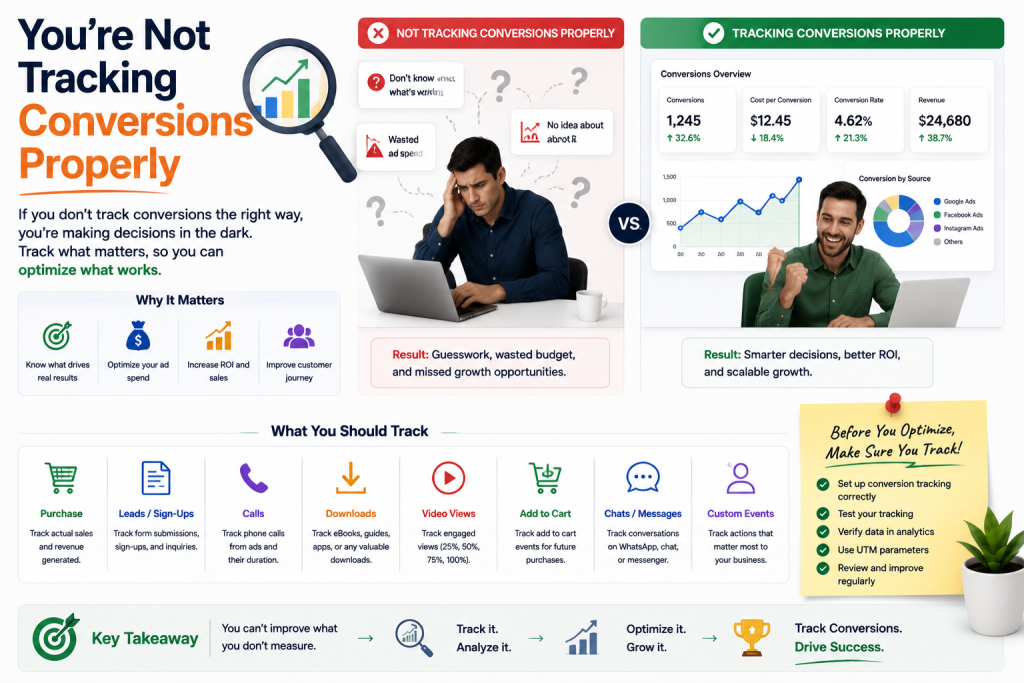
9. You’re Not Tracking Conversions Properly
Without conversion tracking, you’re making decisions based on assumptions instead of data.
Many businesses only measure clicks while ignoring what happens after users visit their website.
How to Fix It
Track important actions such as:
- Purchases
- Form submissions
- Phone calls
- Newsletter sign-ups
- Downloads
Analyze metrics like:
- Cost Per Acquisition (CPA)
- Return on Ad Spend (ROAS)
- Conversion Rate
- Customer Lifetime Value (CLV)
Data-driven decisions consistently outperform guesswork.
10. Your Budget Is Too Small
Sometimes campaigns don’t produce enough results because they lack sufficient budget to generate meaningful data.
Very small budgets may prevent algorithms from optimizing effectively.
How to Fix It
Allocate enough budget to allow campaigns to gather statistically significant data.
Instead of changing campaigns every day, let them run long enough to identify trends before making adjustments.
Patience often leads to better optimization.
11. You’re Not Building Trust
Customers rarely purchase from brands they don’t trust.
If your advertisements promise too much without proof, users may hesitate to engage.
How to Fix It
Include trust-building elements such as:
- Customer reviews
- Testimonials
- Ratings
- Industry certifications
- Awards
- Secure payment icons
- Money-back guarantees
Social proof increases credibility and improves conversion rates.
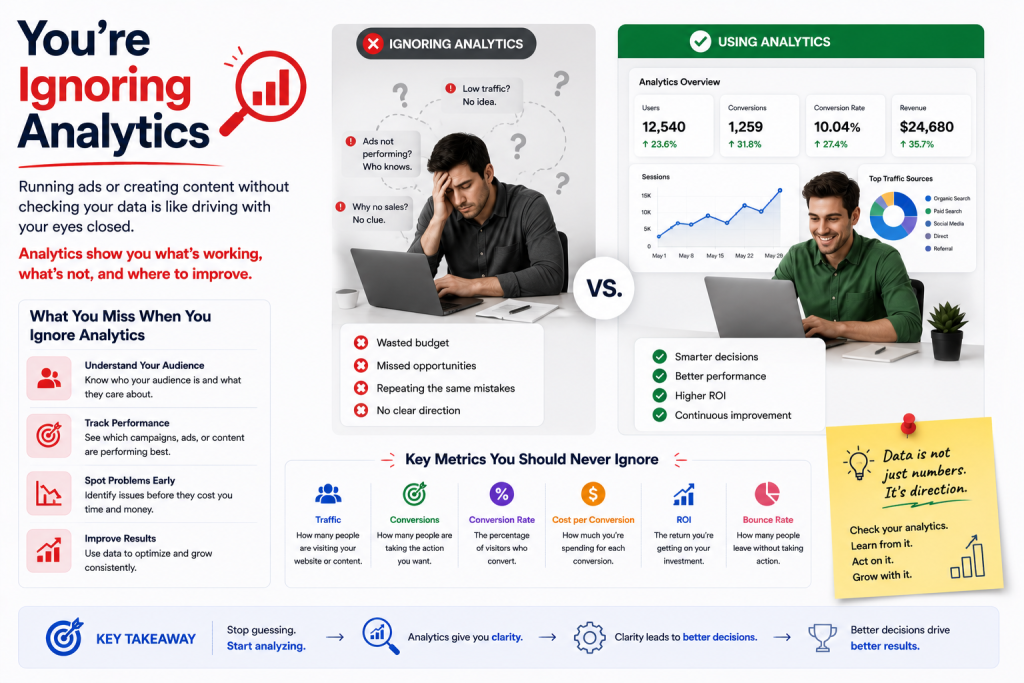
12. You’re Ignoring Analytics
Many advertisers launch campaigns and rarely review performance reports.
Without ongoing analysis, it’s impossible to identify what’s working and what needs improvement.
Monitor Key Metrics
- Click-Through Rate (CTR)
- Cost Per Click (CPC)
- Conversion Rate
- Return on Ad Spend (ROAS)
- Bounce Rate
- Cost Per Lead (CPL)
Regular monitoring enables continuous improvement and better results over time.
Best Practices for High-Performing Ads
To maximize advertising success:
- Understand your target audience.
- Write compelling, customer-focused copy.
- Use professional visuals.
- Optimize landing pages.
- Ensure a fast mobile experience.
- Test multiple ad variations.
- Track conversions accurately.
- Monitor campaign performance regularly.
- Make data-driven decisions.
- Continuously refine your strategy.
Advertising is an ongoing process of testing, learning, and optimization.
Conclusion
When ads fail, it’s rarely because advertising itself doesn’t work. More often, campaigns underperform due to avoidable issues such as poor targeting, ineffective messaging, weak landing pages, or a lack of optimization.
The most successful advertisers don’t rely on luck. They continually analyze data, test new ideas, and refine every aspect of their campaigns. By focusing on the right audience, creating compelling content, improving user experience, and making informed decisions based on analytics, businesses can dramatically improve advertising performance and achieve a stronger return on investment.
Rather than viewing unsuccessful campaigns as failures, treat them as valuable learning opportunities. Every campaign provides insights that can help you create more effective ads in the future. With the right strategy, consistent optimization, and a customer-first approach, your advertising efforts can become a reliable engine for sustainable business growth.